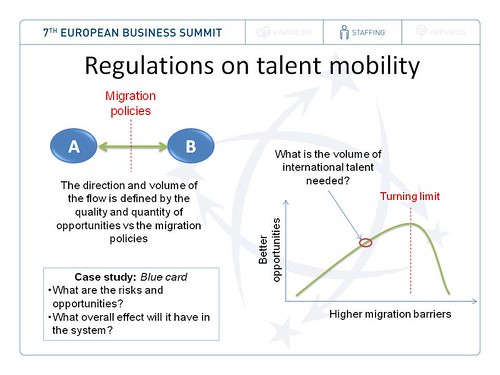
I have been invited to attend the European Business Summit (EBS) - http://www.ebsummit.eu - in Brussels this Thursday.
I will be in a workshop discussing the topic of "Economic Migration to Europe: brain drain or brain gain?"
And I would like to know your opinion to share it with the audience and policy makers of the European Union.
The question is:
How can the EU provide access to opportunities for international young people without negatively affecting developing countries and positively impacting the socio-economical development of the Union?
Drop me a comment and I will take your inputs to the right forum!
In less than 5 months my contract will finish and I have already started to put together some toughts on how and where to move forward.
I started with my CV, which I mentioned in the post Job Wanted, and now I feel that I am moving forward for a deeper research on my values, interests and passions.
I have done a lot of reflection this week, mostly fueled by the fact that my team got quite shaken with the pressure of IPM and we all needed to review our behaviours, their source and their impact in the whole.
As part of this exercise, I tried to bring together what I call my fundamental values. Those behaviours or that environment that I constantly try to build around me to make sure I can perform at my best:
Trust. I trust you and I suspend my judgments until I give you the chance to understand my context and explain me yours.
Loyalty. I stand for my organization (AIESEC) and my team (AI), therefore my behavior seeks to make these entities more meaningful.
Freedom. I take team goals as mine and I achieve them in the way that better fits me considering the connections with others and taking care of the team resources.
Reach out. I ask for what I need, I communicate my admiration, proposals and complaints to the right person (individually) at the right time because one day I want to be a agent of positive change.
Integrity. I do what I say. If I fail, I apologize and take responsibility first, then I do something so that next time it will happen as I promised.
Forgiveness. Crashes of expectations are opportunities to tune relations to a higher level and for me to understand where you are coming from.
Authenticity. I tried to be humble enough to show who I really am and to try to make myself better everyday.
And these are my main interests:
Growth and achievement. I believe that if something is great then my responsibility is to bring it to as many people and organizations as possible. That could change the world.
Supporting others. I can easily empathize with the passions of other people which encourages me to make myself available to support them achieving.
Networks of People. I see them like the key milestone for great achievements.
Sharing of resources. Enabling the flow of individuals, money and knowledge around the networks of people.
International environment. Committing and achieving with individuals from different countries/territories.
Hardcore management. Desigining and implementing strategies, culture, structures, JDs and training for people to perform at their best and make sure the organization achieves.
I find this process of discovery more emotional than I expected. I find myself getting easily excited about new opportunities and generating thousands of great ideas on a daily basis. At the same time, the fact that I can't start right away makes me slow down and then feel ungrounded.
At the end I like it, I feel that I have an blank page in front of me and than in my hand I have all of these colorful pencils very sharp and ready to be used.
I am back from the International Presidents’ Meeting in Italy.
More than 100 countries and territories where AIESEC is present sent their representative to (1) define the global priorities for the next year, (2) elect a new global leadership body, (3) agree on the global framework of operations (regulations) and (4) share their best practices.
It is by far the most challenging Congress I have attended.
Can you imagine how hard it is to run a global decision making process in the context of the global financial crisis?
The representatives arrived to Rome really focused on their country and their needs which made it hard for conversations to be productive. As the time past, the bonds built started to give results and we started to listen to each other and made decisions that supported our intentions.
Later on, the new Membership Fee Model –(this model determines the expenditure each country/territory generates to the global organization and considering the country/territory external and internal capacity, it defines their Membership Fee)- that encourages productivity and achievement of results stretched the organization since some of the European countries were not ready to take financial responsibility for their operations.
Fortunately, the Global Network understood that their markets have constrained and that the changes that we expected all of us to implement were bigger than planned. In the end, in order to move into a phase of efficiency and productivity, the Global Network stepped up to support each other and make sure that we end our meeting with the best engine to achieve the goals of 2009. My reading of the Congress is we are aware that this is the moment to take a better competitive position by building strategic partnerships with organizations that we have considered competitors in the past.
I am very very excited about the future of AIESEC. We are moving into an era of innovation and creativity to make sure that our understanding of the market is translated through actions into a better competitive position, distribution of resources (talent and money) and leadership to make our organization more efficient and impactful.
None of this would have been achieved if two fundamental pillars of all conversations wouldn’t have been present: trust, which gives time to listen, and sense, which conquers bright minds.
We are at the middle of the Global Financial Crisis and the Job Market looks awful for anyone looking for stable full time position but…
Here I go! To the Job Market!
First of all, I have noticed that organizations are looking to keep low fix costs in two ways:
They are keeping the fixdown by lowering the number of full-time employees (FTE) with flexible HR capacity (short-term contracted employees and consultancy) and keeping the costsdown by providing opportunities for hard working candidates with relative little experience.
Furthermore, not all industries suffered the same with the crisis. For example banking and finance got deeply damaged while the energy sector has remained a bit more stable.
On the personal note, I realized that I need to do more than one thing next year and I would like it to be a combination of being an employee, an entrepreneur, a student and a traveler.
I also know that I have the chance to break the year in segments and find short and intense opportunities instead of only looking for a long term career plan, opening the doors to contract and negotiate out-of-the-box, in other words, it is not only about the salary.
In terms of location, anywhere but Europe and USA seems to be the answer which challenges my search because I am currently living and enjoying The Netherlands.
I got a CV and I got a coach. I haven’t met with my coach yet but we will very soon.
While writing my CV, I re-learn 4 things that I want to share:
1.Keep a standard CV but customize it every time you send it to an organization
2.Do that by making sure that the key words in your CV fit the job requirements
3.Make sure you explain what degree you have, you will be amazed to realize the differences between Bachelor, Licentiate, Master and MBAs in different parts of the world, even within Europe.
4.Network your way in, instead of letting yourself being fished out of the market
5.Your CV is your statement, so if it is not you then It won’t get you where you fit
I fool myself by facing the truth: my next step is only that, my next step, one dot in a long line that I will keep on shaping forever.
Finally, I maintain the motivation because life is full of opportunities and places to see and explore. I have met people and build networks that can take me far and in moments of uncertainty people focus on generating results globally, not giving excuses and connecting short term achievements with long term sustainability.
Today is the first Sunday since I left to Costa Rica that I have the chance to stay at home and enjoy the evening shows.
I was watching BBC and saw a documentary that mentioned the issues that have emerged in some Amazonian areas due to the industry of cocaine.
In the height lands of the Andean Region of South America, the Coca Plant has been grown for centuries. It is recognized as a medicinal plant and it is embedded in many traditional activities of the local communities.
When the global consume of cocaine grew in the early 70´s some Andean farmers started to have a new set of clients for their coca leaves.
The new clients paid more than the traditional market and this encouraged the farmers to commit more land to the coca production.
Nowadays, after decades of guerrilla, corruption and violence many families remain dependant of the income of the cocaine industry.
Governments set regional quotas on how much land can be dedicated to the production of coca for the local consumption but leaks to the drug industry remain systematic.
The drug industry is driven by a worldwide consuming market and its power has crashed against the different policies that governments have tried to enforce along the supply chain.
In my opinion, these policies haven't being successful since they are generating a ¨mirage" effect. To give you an example, the enforcement of law and well implementation of policies in Colombia cause the migration of the business to Mexico. Furthermore, as the Mexican government puts more pressure on the markets, the industry will keep moving south to Central America: first to Guatemala and then to El Salvador, Honduras and Nicaragua to finally hit Costa Rica and Panama.
The complexity of the problem doesn't encourage me to propose concrete actions except to extend you an invitation to avoid at all consequences the consumption of any type of illicit drug to stop the supply of money in the market and to reduce the power of the industry.
During one of the unexpected moments in the last Conference I attended in the USA we played the video below. It can only be seen from the blog -http://juan-cajiao.blogspot.com -
It was made by Discovery Channel and I just love it!
ROTTERDAM, December 16 th, 2008- Speaking to AIESEC in Finland, Martti Ahtisaari recalled warmly his time in AIESEC, as a university student. Mr Ahtisaari was a member of AIESEC in the early 1960’s and continues to endorse the relevance of working with young people to build peace and international co-operation.
I had the chance to look at my country with the eyes of a person who has been abroad in the past four years.
I re-discover the beauty of nature and the kindness of the people and I also had a taste of the many management challenges the country is going through.
In my opinion, Costa Rica did not prepared to host the population that we currently have, the immigrats that have arrived and the quality of life we all expected.
The symptoms can be experienced on a daily basis when you get caught in a traffic jam, suffer of long waits for low quality governamental services or feel insecure at your own home.
I have been following politics in my country since 1998 when I joined University and I have realized that we have been sticking bandages in the system and trying to stop the licks with our fingers.
I can't really blame the government. Since 1998 we have had 3 different democratically elected Presidents and every time they have became the scape goat for all the country's problems. If I ask my older brother or my dad, they will add at least 3 more Presidents since 1978. In other words, doesn't really matter who the President is because the attitude of our people remains the same.
I believe that Costa Ricans work very hard as long as they see a direct, short term return in their work. We take care of our families and friends but feel little sympaty for strangers of our own community. We go from University to Business Schools but not usually to start our own ventures. We have a say in politics but not always an action in society. Like the old saying barking dogs don't bite!
I wish Costa Rica would start a long term planning process for the next 25-35 years with clear population targets and strategies around key areas of development like health, housing, education, transport, jobs, finances and retirement supported by strong pillars on national security, environment, heritage, technology and positioning.
I wish one day each productive, social and political sector, each organization and each person in this country will be delivering on an agreed contribution that will lead us to provide each individual the opportunity to be as great as he or she can be.
And I guess it is all a matter of will, good (political) will.
Last night I arrived to Costa Rica after facing the regular migration challenges of a Latin American crossing the world.
But I have to say that I really enjoyed the flight because I decided to use it to reflect in the past 7 months and the experiences that I have lived. So I bought three magazines on topics like leadership, entreprenuership and global reality to facilitate the process and sat in the airplane for over 15 hours and free coffee.
In February 2008 I was elected President of AIESEC International, which means that I have to select 22 people and create an international team to support the operations of AIESEC around the world.
In May we started with the Transtion, in June the 22 members of the team arrived from 16 different countries, by the first week of July we had our plan created - Connecting to deliver -, in August we met in Brazil with more than 1000 members, partners, Alumni, guests and friends to focus the deliverables of our year. In September we deployed the team to support operations, do sales and deliver partnerhsips. We have been constantly present in 6 regions of the world. By October, we started the review of all our activites as we diagnosticated that our organization needed to get fit to succesful overcome the global financial crisis. And today, we have grown 20% over the last year and reached an absolute delivery higher than the past 15 years.
All of this has helped me to become more selfware and to realize some key aspects that I need to pay more attention to play the role that the job requires.
I feel confident when it comes to build focus and direction with the team, also I have noticed that I give a good level of trust to the capabilities of the each individual and that I enjoyed jumping from the detail of the execution to the scope of strategy.
The aspect that I will commit to improve in the next months is empathy. I am a little bit impatient and not always recognize that others are not aware of the context and they don't own the level of information that I have access to. So, when the need to make decisions faster increases I have the tendency to put too much pressure on the individuals without considering the factors affecting them.
So far, this aspect hasn't generated big issues mostly because I have built a strong safety net around me through the support of key individuals in my team that I constantly invite to give me feedback on my behaviours and the reactions of others.
I have learned a lot these months and I am very very impressed with the level of people I worked with everyday. These are guys that understand what is commitment and that have given everything they have to support our countries delivering great experiences.
At this point in time, this team of 22 people represent what I care about and value the most in my life and I am very happy that I decided to live this experience.
A popular question flowing around business minds these days is: how can we decrease capacity to increase results?
This fundamental question is becoming the leverage point for many organizations facing the challenges of the financial crisis.
It is leading organizations to review their bottom-line together with the processes that deliver in such results. It has also time-framed opportunities as well as quantified return on soft investments.
That question has also generated a strong review on HR practices promoting leaner processes in talent supply and shorter retention lenghts, aiming to result in a lower number of Full Time Employees(FTE), which adds to the increasing entry-levels supply looking for exciting opportunites.
More young talent, more short term opportunities, faster supply processes results in a thriving talent market around the world.
In the last edition of Harvard Business Review(HBR), there is an article on: "Winning the Race for Talent in Emerging Markets" which is a remarkable study on what young talented people is looking for in a career opportunity: a brand that inspires and make you proud, a purpose that fulfills your sense of existence, an opportunity that challenges you in new way and a culture that recognizes and promotes success.
When I finished reading, I realized that this is the reason why AIESEC is making it through the financial crisis -we have reported growth in all quarters with an average of 25% from the past year- : because we are a source of talented young people that has been able to create the connection between promises made and promises kept to our partners and ourselves.
Our organization is aiming to grow 100% in the last quarter of the year (October, November and December) compare with the same period of 2007.
The decision to grow 100% is based in what is left to achieve our 2008 goals and what we have in process and almost ready to be delivery.
From my point of view, the challenges to achieve such ambition are organizational focus and members mindset.
The first challenge is to keep a relevant part of our organization focusing on: (1) matching our students with the opportunities we have available, (2) recruit new students intersted in development work and education, (3) and sell more management internships.
The second challenge is the mindset. I have came to realize that not everyone feels comfortable with the verb 'grow' and more interesting that some of us have the tendency to separate growth from quality, as if those aspects would make sense indepedently from each other.
Let me give you an example, a Pizza place is decided to sell more pizzas. When a customer orders a pizza, his/her first expectation is to get the pizza (deliver our promise) and then enjoy the pizza at an affordable price (sustainably). In that way, the customer will come back next time and bring friends along (exponential grow).
Growth in the scale of 100% can only be achieve when the focus and the mindset are aligned and when we bring the organization together building synergies around our common goals.
Check out this video from our partners talking about the 100% Growth Campaign:
The last week I had the luck to visit Slovakia and Germany where our organization had two very important meetings with the our local officers.
I met lots of cool young guys and girls from Europe who commit at least 30 hours of their week in giving others the opportunity to become the person they want to be.
Among them there is a group that we call "LCPs", which stands for Local Committee President. They are the final responsible of our Local Committees and they lead our operations in Universities or Cities across Europe and the World.
Meeting them was an awesome experience, I realized how lucky I am to have the opportunity to share the same goal, the same passion and the same challenges with such a diverse group. It made me feel alive and part of somewthing more powerful than myself.
Everyday these guys and girls work hard connecting their teams, Universities, the local companies and the rest of our organization to increase the impact that we have in the world.
One day, just after the end of WW II, one of these LCPs in Finland found a student: Martti Ahtisaari who joined him in the adventure of learning how to connect people from different countries and to build friendly relations among them. This week, this fellow AIESECer, has been rewarded with the Nobel Peace Prize for his efforts in several continents to solve international conflicts.
Everyday, AIESEC is enabling the development of agents of positive change to create the needed impact on society.
Every time I travel I research to find out if I need a visa to enter the country. As a Costa Rican, I am very lucky to have free access to many countries of the world but that doesn't mean that I have had a hassle-free record of migration issues.
For example, September last year a Schengen immigration authority stopped me for 12 hours and charged me 2200 Euros -refundable- to enter the region while having a valid entry for 10 more days of 90 days valid entry. Note that such restriction in not mention in the website: http://costarica.nlembajada.org/asuntos_consulares/visa.
I felt awful. I felt like a thief stopped by the police in front of everyone, I felt irresponsible for something that was not my responsibility and I felt frustrated because there was nothing I could do.
I know many cases of great individuals with great intentionsbeing stop for reaching their final destination because of these rules, or lack of them, that our countries have set to regulate the mobility of people.
The last example I know is about a Mexican trying to reach India to support countries in the Asia-Pacific Region running projects in social and business entrepreneurship. I am sure he is a harm for national security or a threat for income distribution in the country.
Our World need wiser systemsto regulate the flow of people, resources and technology to make sure that this three elements of development converge in the same place at the same time. Otherwise we will end up with a rich world of starving high technologized people.
This time I will be sharing my experiences and learning of managing a team of 22 individuals from 16 countries and being held responsible for the growth and sustainability of a global organization present in more than 100 countries with more than 32 ooo members. Isn't this cool?
I will be posting on leadership and team management, the challenges of youth in a globalized society and other topics and issues I must face in the next months. The blog will remain young and fresh with a very simple language and some Spanish words here and there.
When I was back in Costa Rica in early 2000's, the TV was a great source of motivation for me. Watching channels like People & Arts, Discovery and NatGeo kept me interested in discoverying the beauty the world captures. Today I have being in more than 67 cities in 34 countries and the video below resembles how i feel about it.
Costa Rica has tried for several years to create a difference in the coffee market offering high quality and responsible production.
Today I was reading the newspaper and I found out that our coffee has won three times, including this year, the "Black Apron Exclusives" to the best supplier of the firm.
But the cooperation goes beyond the supply of coffee. It also includes production management, forecast, loans and diversification of products.
For example, some of the handcraft you can buy there are made in Costa Rica and the suppliers are very much satisfied for the remuneration they receive.